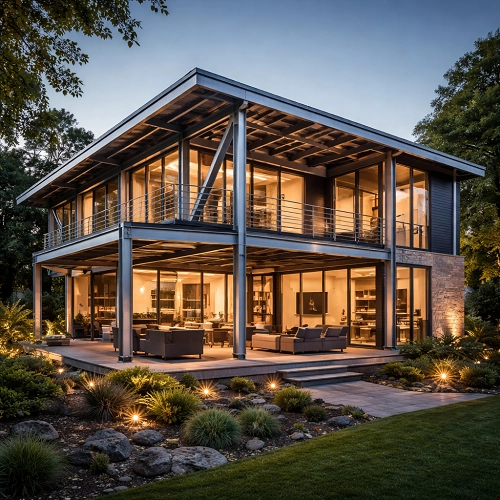
Steel frame homes represent a significant evolution in residential construction, combining advanced engineering principles with modern sustainability and performance requirements. Once associated primarily with commercial and industrial buildings, light-gauge steel framing has become an increasingly viable and attractive alternative to traditional wood framing for single-family homes, multi-story residences, and modular housing systems.
What Are Steel Frame Homes?
Steel frame homes use cold-formed (light-gauge) steel members—typically C-shaped studs and U-shaped tracks—as the primary structural system. These components are manufactured from galvanized sheet steel, cold-rolled to precise dimensions.
Key Components
- Steel studs (vertical load-bearing members)
- Tracks (top and bottom horizontal members)
- Joists and rafters (floor and roof systems)
- Bracing systems (shear walls, strap bracing, or steel panels)
- Fasteners (self-drilling screws, bolts, anchors)
Unlike hot-rolled structural steel used in skyscrapers, cold-formed steel is lightweight, dimensionally precise, and optimized for residential-scale loads.
Structural Engineering Principles
Load Path and Structural Behavior
Steel frame homes rely on clearly defined load paths:
- Dead loads: self-weight of steel, finishes, roofing
- Live loads: occupants, furniture, snow
- Lateral loads: wind and seismic forces
Steel framing excels in predictable elastic behavior, meaning it deforms consistently under load and returns to shape when loads are removed, provided stresses remain within design limits.
Strength-to-Weight Ratio
Steel offers an exceptional strength-to-weight ratio:
- Allows longer spans with smaller members
- Reduces foundation loads
- Enables more open architectural layouts
Seismic and Wind Performance
Steel’s ductility makes it particularly effective in:
- Seismic zones, where controlled deformation absorbs energy
- Hurricane-prone regions, where steel framing resists uplift and racking
Materials Science and Corrosion Protection
Galvanization
Residential steel framing is typically coated with zinc (G90 or higher) to resist corrosion.
Zinc acts as:
- A physical barrier
- A sacrificial anode, protecting exposed steel edges
Longevity
When properly designed and detailed:
- Steel frames can exceed 75–100 years of service life
- Performance is largely unaffected by moisture, insects, or rot
Thermal Conductivity Considerations
Steel is highly conductive, which introduces challenges related to thermal bridging—a major technical issue addressed through:
- Continuous exterior insulation
- Thermal break materials
- Advanced wall assemblies
Design and Architectural Flexibility
Precision and Tolerances
Steel framing is manufactured with tight tolerances:
- Straighter walls
- Flat floors and ceilings
- Reduced framing variability
Complex Geometry
Steel enables:
- Cantilevers
- Large window openings
- Curved or non-standard wall shapes
- Multi-story structures with reduced wall thickness
Integration with Modern Design
Steel framing pairs well with:
- Prefabrication and modular construction
- High-performance building envelopes
- Contemporary architectural styles
Construction Methods and Techniques
On-Site Framing
- Similar workflow to wood framing
- Requires specialized cutting tools and screw guns
- Emphasizes precision and layout accuracy
Panelized and Prefabricated Systems
- Wall, floor, and roof panels manufactured off-site
- Faster erection times
- Improved quality control
- Reduced jobsite waste
Fastening and Connections
Self-drilling screws dominate residential applications
Structural connections must account for:
- Pull-out resistance
- Shear capacity
- Vibration and fatigue
Building Envelope and Energy Performance
Thermal Bridging Challenges
Steel’s conductivity can significantly reduce effective R-values if not addressed.
Mitigation Strategies
- Exterior rigid insulation (continuous insulation)
- Insulated sheathing systems
- Advanced framing layouts
- Double-stud or hybrid wall assemblies
Airtightness
Steel framing supports high-performance envelopes:
- Minimal shrinkage or warping
- Stable air barrier systems
- Excellent compatibility with spray foam and membrane-based systems
Fire Resistance and Safety
Non-Combustibility
Steel is inherently non-combustible:
- Does not contribute fuel to a fire
- Limits fire spread within wall cavities
Fire Performance
Steel retains strength up to certain temperatures
Fire-rated assemblies rely on:
- Gypsum board layers
- Fire-resistant insulation
- Tested UL or ASTM assemblies
Sustainability and Environmental Impact
Recyclability
- Steel is 100% recyclable
- Typical residential steel framing contains 25–70% recycled content
Resource Efficiency
- No deforestation
- Consistent material usage
- Reduced construction waste
Life-Cycle Assessment
While steel production is energy-intensive:
- Long service life
- Minimal maintenance
- Recyclability offset embodied energy over time
Cost Considerations
Material Costs
- Steel prices fluctuate with global markets
- Often higher upfront material cost than wood
Labor and Efficiency
- Faster construction with experienced crews
- Lower waste and rework
- Potential savings in insurance and maintenance
Long-Term Value
- Reduced risk of termite damage
- Lower maintenance costs
- Increased durability in extreme climates
Codes, Standards, and Compliance
Building Codes
Steel frame homes are governed by:
- International Residential Code (IRC)
- International Building Code (IBC)
- AISI (American Iron and Steel Institute) standards
Engineering Requirements
- Precise load calculations
- Connection detailing
- Compliance with fire and energy codes
Inspection and Training
- Inspectors and contractors require steel-specific knowledge
- Proper installation is critical to performance
Challenges and Limitations
Despite their advantages, steel frame homes face challenges:
- Limited contractor familiarity in some regions
- Need for careful thermal detailing
- Acoustic transmission requiring sound-control strategies
- Market perception favoring traditional wood framing
Steel frame homes represent a technologically advanced, resilient, and sustainable approach to residential construction. With superior structural performance, durability, and compatibility with modern building science, steel framing is well-positioned to meet the demands of future housing—especially in regions facing climate extremes, resource constraints, and stricter building codes.